"Why We Explain Ourselves But Label Everyone Else"
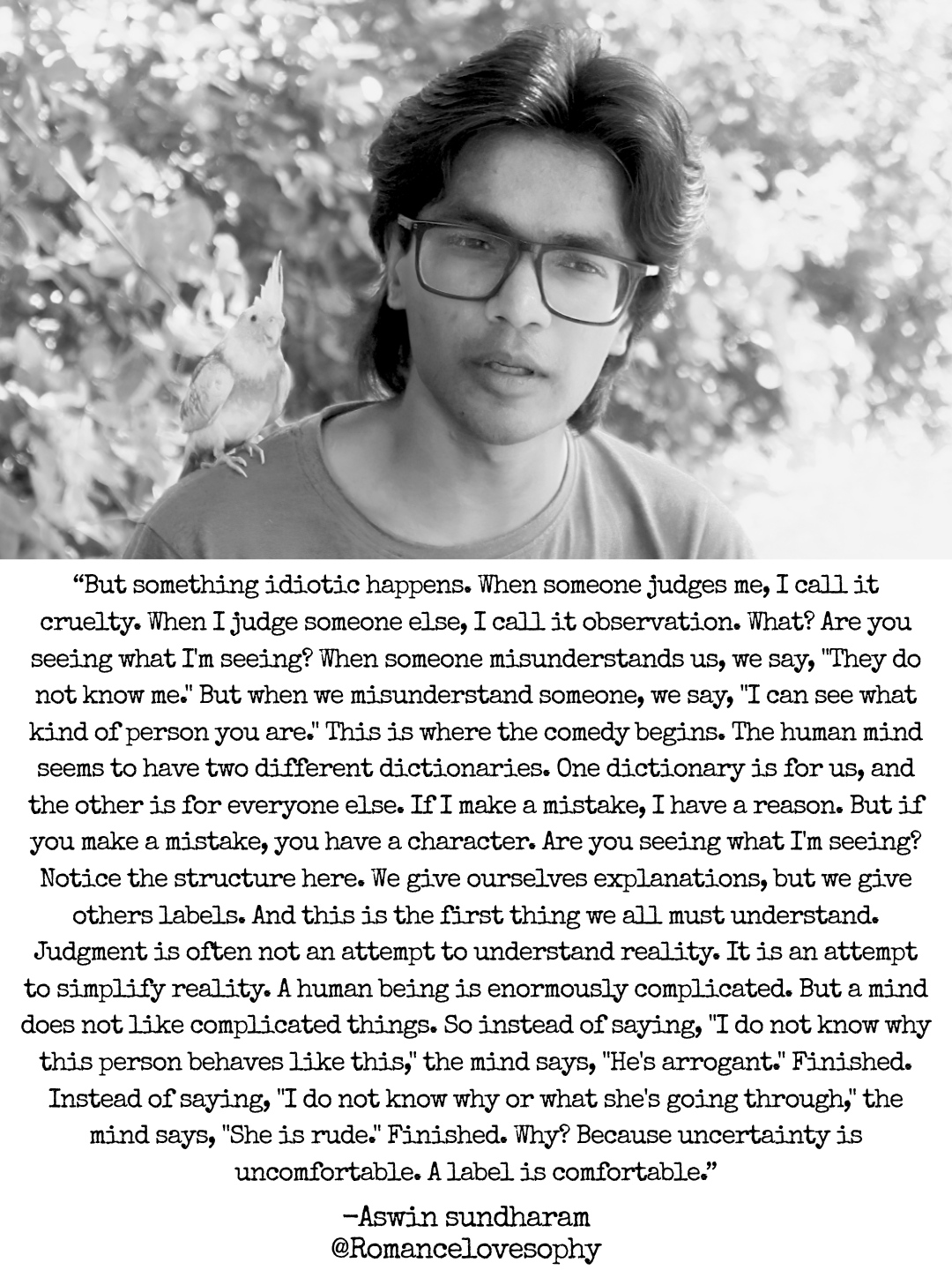
“But something idiotic happens. When someone judges me, I call it cruelty. When I judge someone else, I call it observation. What? Are you seeing what I'm seeing? When someone misunderstands us, we say, "They do not know me." But when we misunderstand someone, we say, "I can see what kind of person you are." This is where the comedy begins. The human mind seems to have two different dictionaries. One dictionary is for us, and the other is for everyone else. If I make a mistake, I have a reason. But if you make a mistake, you have a character. Are you seeing what I'm seeing? Notice the structure here. We give ourselves explanations, but we give others labels. And this is the first thing we all must understand. Judgment is often not an attempt to understand reality. It is an attempt to simplify reality. A human being is enormously complicated. But a mind does not like complicated things. So instead of saying, "I do not know why this person behaves like this," the mind says, "He's arrogant." Finished. Instead of saying, "I do not know why or what she's going through," the mind says, "She is rude." Finished. Why? Because uncertainty is uncomfortable. A label is comfortable.”